
Hernia Repair Surgery
A hernia is a common medical condition that occurs when an organ or tissue pushes through weakened muscle or connective tissue.
If left untreated, some hernias can cause discomfort, pain, and severe complications. Other times, hernias are not severe enough to require removal surgery. Your provider will advise on the best treatment option for you.
What Is a Hernia?
A hernia occurs when an organ or tissue pushes through a weakened area in the muscles or connective tissue responsible for holding it in place.
The most common types include inguinal (groin), incisional, and umbilical hernias.
These conditions can develop slowly from surgery, strain, aging, or weakness, or they can occur suddenly from strenuous activities.
Regardless of the cause, surgical repair may be necessary to prevent complications.
Signs and Symptoms
Hernias develop in various ways, but common signs and symptoms include:
- A bulge or lump in the affected area, which may become more prominent when standing, coughing, or straining.
- Discomfort or pain, especially when lifting heavy objects or engaging in physical activities.
- Feeling heaviness or pressure in the affected region.
- Persistent indigestion or acid reflux, which can be a sign of a hiatal hernia.
Learn More
Hiatal Hernia Repair
Learn MoreHiatal Hernia Repair for GERD
A hiatal hernia occurs when a portion of the lower esophagus or stomach itself pushes through an opening in the diaphragm. This can cause gastroesophageal reflux disease, or GERD. Learn more about hiatal hernia repair surgery to treat GERD.
How Are Hernias Diagnosed?
Diagnosing a hernia typically involves a health care provider conducting a physical examination.
They will inquire about your symptoms and medical history and perform a physical assessment to locate the affected area.
Doctors may request additional tests such as ultrasound, CT scan, or MRI scan.
These tests confirm the diagnosis and help doctors evaluate the size and severity of the affected area.
Hernia Treatment Options
Treatment options include watchful waiting, lifestyle changes to address symptoms, and surgical repair. Although small hernias do not always require surgery, hernias do not resolve on their own.
Hernias typically will require surgery to heal completely and to avoid further complications.
Your doctor can evaluate the affected area and the risks to help come up with a treatment plan.
How Long Does Hernia Repair Surgery Take?
The duration of these surgeries can vary depending on the type and complexity of the hernia repair.
These surgeries are usually fast, lasting 30 minutes for simple repairs and up to two hours for complex operations.
The timing will vary depending on the size, location, and severity of the hernia and affected area.
Recovery After Hernia Surgery
Recovery following hernia repair surgery is similar to most common operative procedures.
Patients can usually return home on the same day or after a short hospital stay, depending on the surgical approach.
Once home, you should take it easy, especially during the first 24 hours.
Your health care team will provide you with guidance on specific post-operative procedures.
This will help you fully recover as quickly as possible.
Is Hernia Repair a High-Risk Surgery?
Surgeons generally consider hernia repair surgery to be low-risk and routinely perform it with a high success rate.
More than 1 million hernia repair surgeries are performed each year in the United States. As with any surgery, there are potential risks.
The overall risk depends on various factors, including the patient's health, the hernia type, and the surgical approach.
It's crucial for patients to discuss these risks and benefits with their surgeon before undergoing treatment.
If you suspect or have been diagnosed with a hernia, it is important to consult a doctor.
They will be able to recommend the most suitable treatment for your specific condition.
Early intervention and a thorough understanding of hernia repair options can lead to a smoother recovery and improved quality of life.
Hernias: Types and Repairs
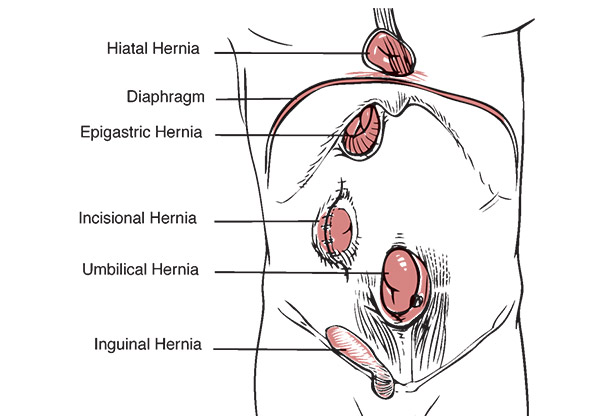
A hernia occurs when an organ or tissue pushes through a weakened spot in the abdominal wall, resulting in a bulge or protrusion. Hernias can be categorized into different types, depending on what part of the body they occur.
Common Causes of Hernias
- Heavy lifting
- Straining during bowel movement
- Chronic coughing
- Activities that increase abdominal pressure
- Congenital weakness in the abdominal wall
Types of Hernias
Groin Hernias (Inguinal Hernias)
- Most common type
- Affects both men and women but is more prevalent in men
- Can occur due to various causes, including heavy lifting and chronic coughing
Inguinal hernia occurs in the lower abdomen and occurs when tissue, like the intestines, pushes through a weakness in the abdominal muscles. Although less common, the bladder may also protrude. The condition itself is not life-threatening but complications which arise as a result of the hernia can be dangerous and require immediate care.
Inguinal hernia is named so because it appears above the inguinal canal, which contains the spermatic cord in men. Symptoms include unusual bulging on either side of the pubic area that may be accompanied with burning or aching pain in the area of the bulge, pain when bending, squatting, lifting, or coughing.
Additional symptoms include an unusual heavy or dragging sensation in the groin area, and weakness or pressure in the groin area. When the protrusion reaches the groin area, it may cause severe pain and swelling.
Incisional Hernias
- Occur at the site of a previous surgical incision
- Common in individuals who have had abdominal surgeries
- Repair surgery involves placing the tissue or organ back in place and reinforcing the abdominal wall
This type of hernia can occur soon after surgery or even years later. It is often very painful and requires surgery. If you think you may have an incisional hernia, schedule an appointment with your doctor to determine the best treatment plan for you.
Femoral Hernia
- Occurs at the top of the inside of the thigh
- More common in senior women
- Repair surgery can be performed through open surgery or minimally invasive methods
Femoral hernia is a hernia that appears at the top of the thigh near the groin. Named for the femoral canal that contains the femoral artery, it is found just below the groin ligament. Less than 5% of all hernias are femoral and may be small enough that you are not even aware of it. Without treatment, you may experience dangerous complications that require immediate care.
Epigastric Hernia
- Occurs between the belly button and breastbone
- More common in men
- Obesity is a common risk factor
- Repair surgery can be performed through open surgery, but laparoscopic robotic surgery will minimize scarring
Epigastric hernia is typically fat or sometimes part of the intestine that pushes through the upper abdominal wall. Other symptoms may include gastrointestinal issues. If you think you may have an epigastric hernia, schedule an appointment with your doctor.
Umbilical Hernias
- Characterized by a bulge near the belly button
- Common in infants and young children due to congenital weakness
- In adults, may be caused by factors like obesity, pregnancy, or abdominal surgery
Umbilical hernias are most common in infants and normally resolve on their own by the time the baby reaches one year. When this condition occurs in adults, the hernia tends to become larger over time, and hernia surgery can repair it. Without treatment, the risk of strangulation is also of concern and can be life-threatening. Careful monitoring is needed to ensure strangulation does not occur. If you think you may have an umbilical hernia, schedule an appointment with your doctor.
Hernia Repair Surgery
Hernia repair surgery is a common treatment for hernias. During the procedure, a surgeon places the protruding tissue or organ back into its proper place and reinforces the weakened abdominal wall with sutures or mesh.
This surgery is typically performed under general or local anesthesia and has a relatively short recovery period. Most patients can return to light activities within a few days and gradually resume normal activities within a few weeks.
Incisional Hernia Repair Surgery
This repair surgery at an incision site typically involves an incision at the affected site.
Then, the surgeon places the tissue or organ back in place and reinforces the abdominal wall with sutures or mesh.
Umbilical Hernia Repair Surgery
Umbilical hernia repair surgery is a common and effective treatment for adults and children with this condition.
This procedure follows a similar process to the other repair surgeries.
Most patients can return to light activities within a few days and normal activities in a few weeks.
Robotic Hernia Repair Surgery
Robotic hernia surgery can be a minimally invasive solution to repair a hernia.
Using robotic technology, your surgeon can perform the surgery with more precision and efficiency. This type of hernia repair surgery also allows your surgeon to close the incision, which is not possible in traditional laparoscopy.
The mesh is then placed in a way that reduces pain, with a much smaller incision than with traditional open surgery.