
Amari’s Journey with Hypoplastic Left Heart Syndrome and DiGeorge Syndrome
Michaella Adamson, 29, was nearly eight months pregnant and enjoying a smooth pregnancy when she and her partner, Karim Williams, 27, moved their family from rural Wyoming to San Antonio in the summer of 2024. With three children already, the whole family was excited to welcome their newest addition.
On Sept. 9, 2024, Michaella and Karim were blessed with a baby boy, Amari Moses Williams. Weighing a healthy 8 pounds, 6 ounces, Amari appeared strong, but he faced serious health challenges from the moment he was born.
He was put on oxygen right away,
Michaella said. The doctors at the hospital where Amari was born said he couldn’t maintain his oxygen levels. They told us they feared he had a very severe case of aortic stenosis, and they said we had to go to CHRISTUS Children’s.
As a nurse, Michaella understood the seriousness of the situation and trusted the doctors’ recommendation to seek specialized care. An ambulance took Amari to CHRISTUS Children’s NICU, and Michaella and Karim followed. Once at the hospital, neonatologist Dr. Cody Henderson quickly stabilized Amari and initiated cardiac testing.
Dr. Henderson was great. He is a reassuring and hopeful, optimistic kind of person. We really needed that and I’m guessing most NICU parents need that,
Michaella said. He was so thorough, and he made himself available to answer all our questions.
Since doctors from the first hospital mentioned aortic stenosis, Michaella had been reading all about the condition, which involves a narrowing of the aortic valve, limiting blood flow from the heart to the rest of the body.
At the time, I thought aortic stenosis sounded so scary,
Michaella said. Then I heard Amari’s actual diagnosis.
When Michaella and Karim met with Pediatric Cardiologist Dr. Ravi Ashwath, and Pediatric Cardiothoracic Surgeon Dr. Victor Bautista-Hernandez, they learned Amari’s diagnosis: hypoplastic left heart syndrome. Without the first of three critical surgeries, babies with hypoplastic left heart syndrome often don’t survive beyond a few days or weeks.
Of course, we immediately consented to surgery because we knew we really didn’t have a choice,
Michaella said.
It was horrible news but at least we felt comfortable quickly because both doctors were so kind and confident,
Michaella said. Dr. B explained the Norwood procedure he would be doing on our son. I’ll admit, we were petrified. But we also felt we had the very best doctor.
CHRISTUS Children's The Heart Center
The Heart Center at CHRISTUS Children's provides comprehensive care to children with heart problems. Our integrated group of specialists bring together a multidisciplinary approach from many specialties to care for children with heart defects.
Hypoplastic Left Heart Syndrome
Hypoplastic Left Heart Syndrome is an extremely serious congenital condition defined by myriad cardiac malformations, including an underdeveloped or completely absent left ventricle. Three surgeries, performed at different ages, are required to give the baby the best chance of survival. The three procedures, the Norwood, the Glenn and the Fontan, make up a staged reconstruction of the heart. These surgeries—performed shortly after birth, between four to six months of age, and around three to five years old—can significantly improve survival and quality of life for individuals with Hypoplastic Left Heart Syndrome.
Advances in surgical techniques and long-term care have greatly improved outcomes in recent decades. Long-term data is still evolving, but survival into adulthood and beyond the age of 30 is increasingly common with modern treatments.
Amari’s First Surgery: The Norwood procedure
On Sept. 18, 2024, about a week after he was born, Amari underwent the Norwood procedure with Dr. Bautista leading the team. Michaella said she was so impressed with CHRISTUS Children’s commitment to keeping parents of surgical patients up to date at every point of the procedure. In Amari’s case, the surgery was expected to last about six hours and the parents felt relieved every time they received a text update about the case.
Dr. Bautista told the parents Amari was a good candidate for a good outcome
on the surgery. And he was right.
Dr. B was so confident and reassuring,
Michaella said I just love him. He has a great bedside manner and, even though the whole thing was super scary, he made me feel like everything was going to be OK.
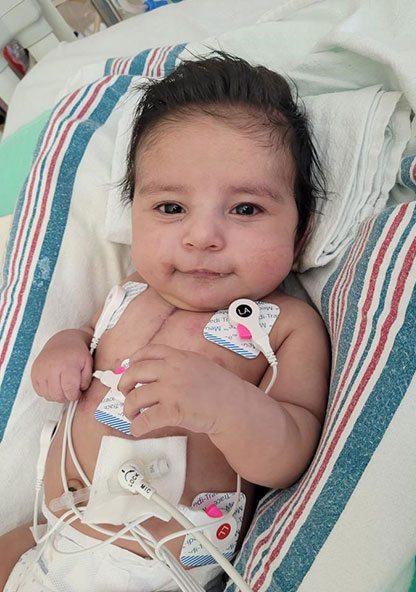
Amari’s parents were able to see him the day after surgery.
Being a nurse, I had an idea what I was walking into,
Michaella said. Even though he had 18 IV lines, he didn’t look as bad as I thought he might. I expected a lot of swelling, but he looked just like his adorable self,
she said. We were so happy. He was alive.
Nurses Katie and Zack from the PICU were a godsend, Michaella said. They took the time to explain each medication Amari was taking, what each of the IV lines were for and how to manage his gastrostomy tube, or G-tube. Although Amari is able to take some breast milk by mouth, he also relies on the G-tube, which was surgically implanted through his abdomen into his stomach, to receive additional nutrition.
Amari is diagnosed with DiGeorge Syndrome
At CHRISTUS Children’s, the medical team ensured that all of Michaella and Karim’s questions were answered.
The doctors had been talking with us about the reasons Amari may have been born with the heart defect,
Michaella said. When they asked if they could do a micro chromosomal test, we figured it was better to know than to wonder.
The test revealed Amari has DiGeorge Syndrome, a chromosomal defect that affects many parts of the body and may cause a wide range of lifelong challenges for Amari.
DiGeorge Syndrome
People with DiGeorge Syndrome are born with a 22q11 deletion, meaning they are missing a small piece of chromosome 22. A heart defect, such as Hypoplastic Left Heart Syndrome, is certainly consistent with a diagnosis of DiGeorge Syndrome. The condition can also cause developmental delays, a compromised immune system and learning difficulties. Like Amari, people with DiGeorge Syndrome also have certain facial features including an asymmetrical mouth and low bridged nose.
Amari’s Continued Care
Amari was discharged from the hospital on Nov. 12 and will continue to have follow-up visits monthly with his cardiology team. The second surgery will likely take place in early 2025. The family will seek guidance from a geneticist to follow Amari’s DiGeorge Syndrome as it progresses and potentially impacts his life.
Michaella said she’s thankful they can rely on the medical expertise at CHRISTUS Children’s.
My intention is to make sure Amari has the best life possible and I will never stop hoping that he has the longest life possible, as well,
she said. We don’t know what the future is going to bring--except two more surgeries.
We do know DiGeorge could mean he will have many uphill battles. But we are going to give him every chance at success by making sure we have the very best medical team available. For our family, that means staying at CHRISTUS Children’s. Whatever comes, we will get him what he needs.”
Learn more about the pediatric cardiology program at CHRISTUS Children’s or the Genetics Clinic at CHRISTUS Children’s.
