
Baby Cade’s Gastroschisis Diagnosis and Lifesaving Surgeries at CHRISTUS Children’s
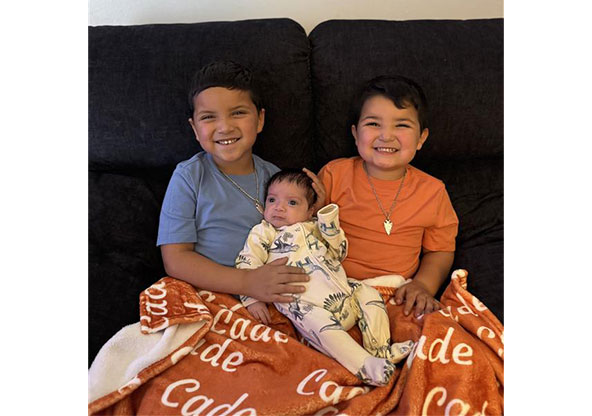
Twenty-five-year-olds Ivy Valdez and Jesse Ledesma were raising their two young sons in Jourdanton, Texas, when they learned they were expecting their third child.
Everything seemed to be going smoothly until a routine 20-week anatomy scan revealed something concerning.
he ultrasound showed something unusual,
Ivy said. At first, they thought my baby had an abdominal hernia. But it was worse than that.
The couple was referred to CHRISTUS Children’s in San Antonio for an appointment with Dr. Reinaldo Acosta, a maternal-fetal medicine specialist.
Dr. Acosta diagnosed their baby with gastroschisis, a rare condition where the intestines develop outside the body through an opening in the abdominal wall.
I had never dealt with anything like this,
Ivy said. I had my worries, but Dr. Acosta answered all my questions. He made sure I felt supported and informed throughout the pregnancy.
Multiple Surgeries to Repair Cade’s Gastroschisis
On May 5, 2025, Ivy was induced and midwife Annalysa Salinas, CNM, helped deliver baby Cade at CHRISTUS Children’s. Finally seeing her son in person was bittersweet. It was love at first sight but also scary,
Ivy said. It was strange to see everything we’d been looking at on the scans in person. It became real.
Cade weighed just under six pounds and was immediately taken to the Neonatal Intensive Care Unit, or NICU. He was placed on oxygen and later that day he underwent the first surgery needed to manage his gastroschisis.
Babies born with gastroschisis require surgery shortly after birth to place their intestines back inside the abdomen and close the opening. At first, learning this was frightening for Ivy and Jesse. But after meeting with Dr. Charlene Dekonenko, a pediatric general surgeon, they felt reassured knowing their baby was in expert hands.
In the NICU, Dr. Dekonenko examined Cade and walked Ivy and Jesse through the first surgery she planned to perform. Her goal, she explained, was to evaluate his intestines and place a temporary pouch called a silo—a sterile, flexible container used to hold and gradually return the intestines into the abdominal cavity.
We were so impressed by how patient Dr. Dekonenko was with us,
Ivy said. She explained everything in detail and gave us a timeline for what to expect. That helped a lot since it was all new to us.
A week later, on May 12, Cade underwent his second surgery. This time, Dr. Dekonenko closed his abdominal wall and created a colostomy. This procedure involves forming a stoma, an opening in the abdomen, to allow stool to bypass the rectum and anus and exit into a colostomy bag. The surgery was necessary because Cade’s large intestine wasn’t fully connected, something known as colonic atresia. The stoma must be kept clean to prevent infection and the colostomy bag is emptied regularly.
Ivy laughs about one unexpected upside of having a colostomy bag: No dirty diapers! At first it was a challenge, but it’s gotten easier.
A couple of weeks after his second surgery, Cade was doing very well and was nearly ready to go home. Unfortunately, just before his discharge, he had a small setback—he caught rhinovirus, a common cold virus—and needed oxygen again from June 1 to June 13. Finally, after 44 days in the NICU, Cade was able to go home on June 18.
He’s been doing really well since he got home,” mom said. “He’s gaining weight, smiling and starting to try to roll over.
Fetal Care Center
Care for Your High-Risk PregnancyFetal Care Center
You don't have to go through your high-risk pregnancy alone. With the maternal-fetal care team at CHRISTUS Children's, you will have a dedicated team of highly-trained specialists to walk with you through every step.
General Surgery Clinic
Meet Our SurgeonsGeneral Surgery Clinic
From complex surgeries to minimally invasive procedures, CHRISTUS Children's General Surgery Clinic provides exceptional care. With a team of experts working together, your child is in good hands.
The Next Step: A Third Surgery to Close Cade’s Stoma
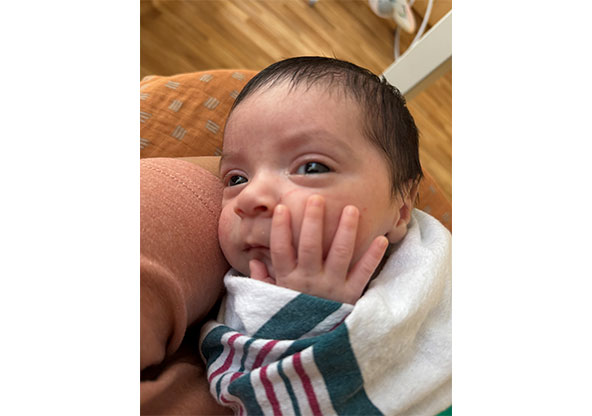
Ivy couldn’t wait to praise Dr. Dekonenko. I love her,
she said. She’s the most helpful surgeon there is. She understood this was our first time facing something like this and always made sure we knew what to expect next.
Cade’s journey isn’t over yet; he’ll return to CHRISTUS Children’s by the end of the year for another surgery to reconnect his intestines, close the stoma and allow his digestive tract to function normally. And, as Ivy is quick to point out, this will mean no more colostomy bag!
Ivy thanks all the nurses at CHRISTUS Children’s for their incredible support in the NICU, especially for teaching them how to manage the colostomy bag. Anytime we needed something, they were always there. We had many nurses, and they were all so great and compassionate,
she said.
For now, she and Jesse are just thankful for how far he’s come.
I want him to keep growing and meeting his milestones,
Ivy said. He’s doing great and waking up only once a night. That’s all that matters right now. We are taking one day at a time.
Cade and Ivy share a birthday week that was the same week as Mother’s Day. This year, she said, Cade was the best gift she could have asked for and all the nurses at CHRISTUS Children’s made a difficult time much more manageable than it could have been.
Ivy added, We had a really good experience at CHRISTUS Children’s. Everyone was so helpful. They made sure we never felt alone.
See how CHRISTUS Children's maternal-fetal care or pediatric general surgery is helping kids like Cade.
